Work, Reimagined with AI.

Services · Outcome as a Service

If it doesn’t move EBITDA, we don’t build it.

Every engagement starts with a P&L line, not a feature list. We find the use cases with a priced outcome, build the workflows, land the change with your people, and prove the number every month.

Software included. Consulting built in. One retainer for the outcome — not the seats.

Security
SOC 2 Type II
Time to live
Live in 30 days
Pricing
No per-seat licenses

The only brief we accept

One P&L line. One owner. One number.

  • Revenuepipeline velocity, win rate, expansion
  • Gross margincost to serve, delivery hours, rework
  • Operating expensehandoffs, approvals, app and license spend
  • Cycle time to cashquote to close, close to invoice, invoice to paid

Baselined in Week 0. Written into an outcome charter. Reviewed at Day 90 and every quarter after.

Why outcome first

AI is everywhere. EBITDA impact isn’t.

Adoption is no longer the problem. Tools get bought, pilots get run, and the P&L doesn’t move — because the work was never redesigned and the people were never brought along. That is the gap our services exist to close.

88%
of organizations now use AI in at least one function
39%
report any enterprise-level EBIT impact from it
6%
attribute 5% or more of EBIT to AI — and most of them redesigned their workflows
95%
of enterprise generative-AI pilots show no measurable P&L impact
74%
of companies have yet to show tangible value from AI
7×
more likely to meet objectives with excellent change management than with poor

Sources: McKinsey, The State of AI 2025 (88%, 39%, 6%, workflow redesign); MIT NANDA, The GenAI Divide 2025 (95%); BCG, Where’s the Value in AI? 2024 (74%); Prosci, Best Practices in Change Management (7×).

ROI-based use case identification

Use cases, priced in margin.

Most AI roadmaps are a list of things that could be automated. Ours is a ledger of things worth automating, ranked by what they return. Nothing gets built until it has a line, a baseline and an owner.

  1. Step 1

    Pick the line.

    We start in the P&L: revenue, gross margin, operating expense, or cycle time to cash. One line, one accountable owner, one baseline number — agreed in writing in Week 0, before anyone opens a tool.

  2. Step 2

    Map the work behind it.

    We shadow the people who do the work and read the process as it actually runs — the emails, meetings, handoffs and spreadsheets — then model the future state with Herd’s process tooling. In person where we can; it is how you find the friction nobody writes down.

  3. Step 3

    Score and rank.

    Every candidate use case is scored on EBITDA impact, confidence, time to value and adoption risk. The top of the ledger is what we build first. The rest stays visible to your leadership, so nothing becomes a pet project.

  4. Step 4

    Commit to the outcome.

    A written outcome charter: the baseline, the target, how it will be measured, and when it will be reviewed — live by Day 30, first review at Day 90, then every quarter. The charter is what the retainer is for.

What we deliver

Four services. One accountable team.

They are not a menu. Every engagement runs all four, because a use case without a workflow is a slide, a workflow without adoption is shelfware, and adoption without analytics is a hunch.

01 · Use case identification

Find the money.

The ROI method above, run as a service: a baseline for the line you choose, a ranked ledger of use cases with their value and their risk, and an outcome charter you can hold us to.

  • EBITDA baseline for the chosen P&L line
  • Ranked use-case ledger: impact, confidence, time to value, adoption risk
  • Application and license rationalization: what the stack costs, what it is used for, what goes
  • Written outcome charter with Day 30, Day 90 and quarterly reviews

What you get in Week 0

  • Baselinethe line, today, with its measurement method
  • Ledgerevery candidate, scored and ranked
  • Chartertarget, owner, review dates
  • Build orderwhat ships by Day 30
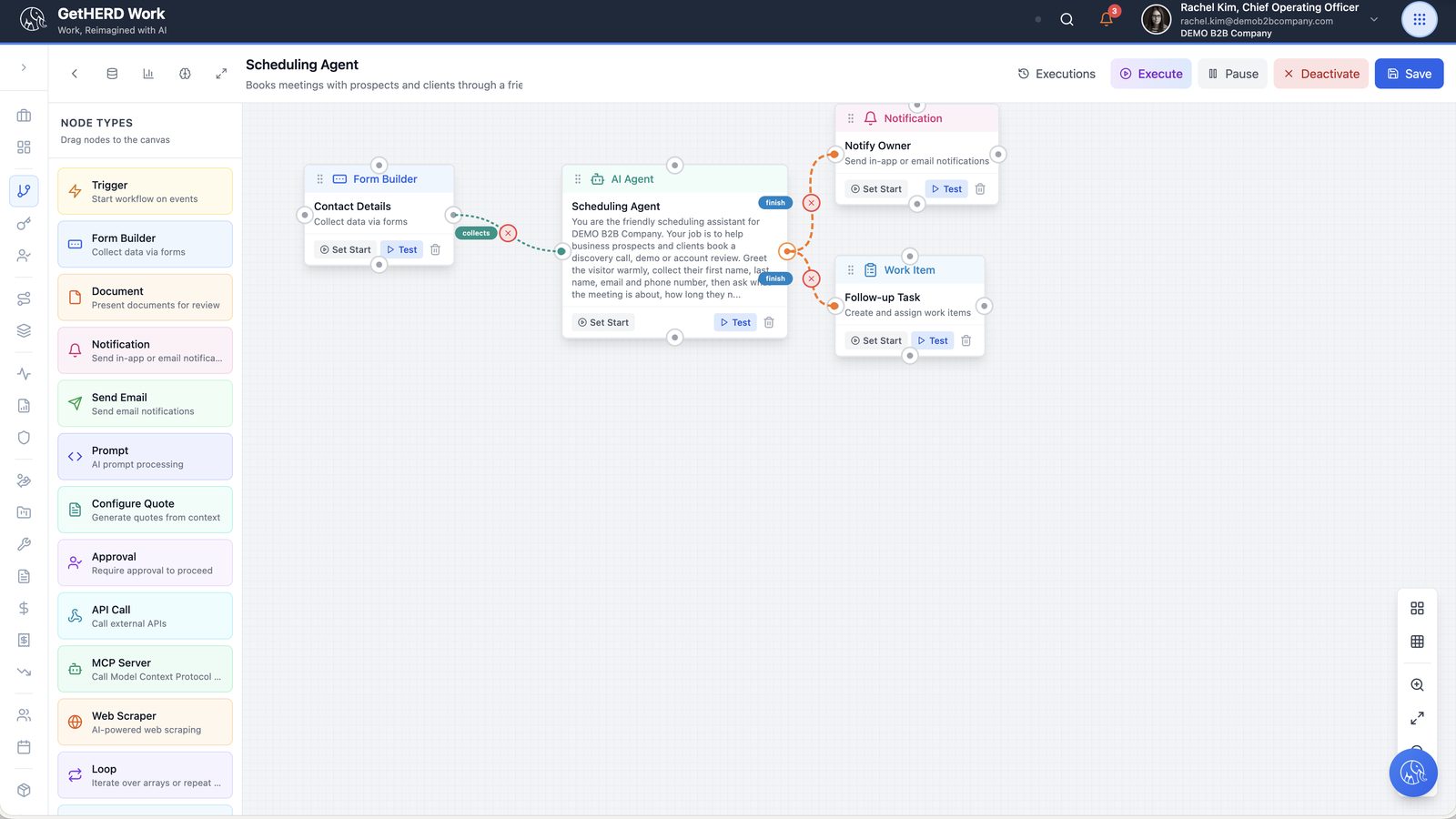
Herd: Work Workflow Builder canvas showing a Scheduling Agent workflow: Form Builder, AI Agent, Notification and Work Item nodes

02 · Workflow building

Build the work.

Reuse first. Build the difference. Review the existing component library before generating code. Budget for integration, security validation and business-specific extensions instead of repeatedly rebuilding common features. See the components.

The use case becomes a running process, not a new codebase for familiar features. We start with reusable Herd components, including Herd FLOW for forms, AI agents, approvals and connected tools, then configure the workflow around your data and business rules.

  • Processes redesigned around AI agents, not AI bolted onto the old process
  • Human approval and hand-off steps where judgment belongs
  • Connected to Teams, Google, calendar and email — no new habits for your people
  • Weekly enhancements after go-live, owned by the same team
See reusable workflows in the product tour →

03 · User change

Land the change.

Projects with excellent change management are seven times more likely to meet their objectives than projects with poor change management. So adoption is not a training module at the end; it is designed in from the first workshop and measured for every person, every week.

  • Role-by-role rollout plans with named sponsors
  • Training inside the workflow — the next step is shown where the work happens
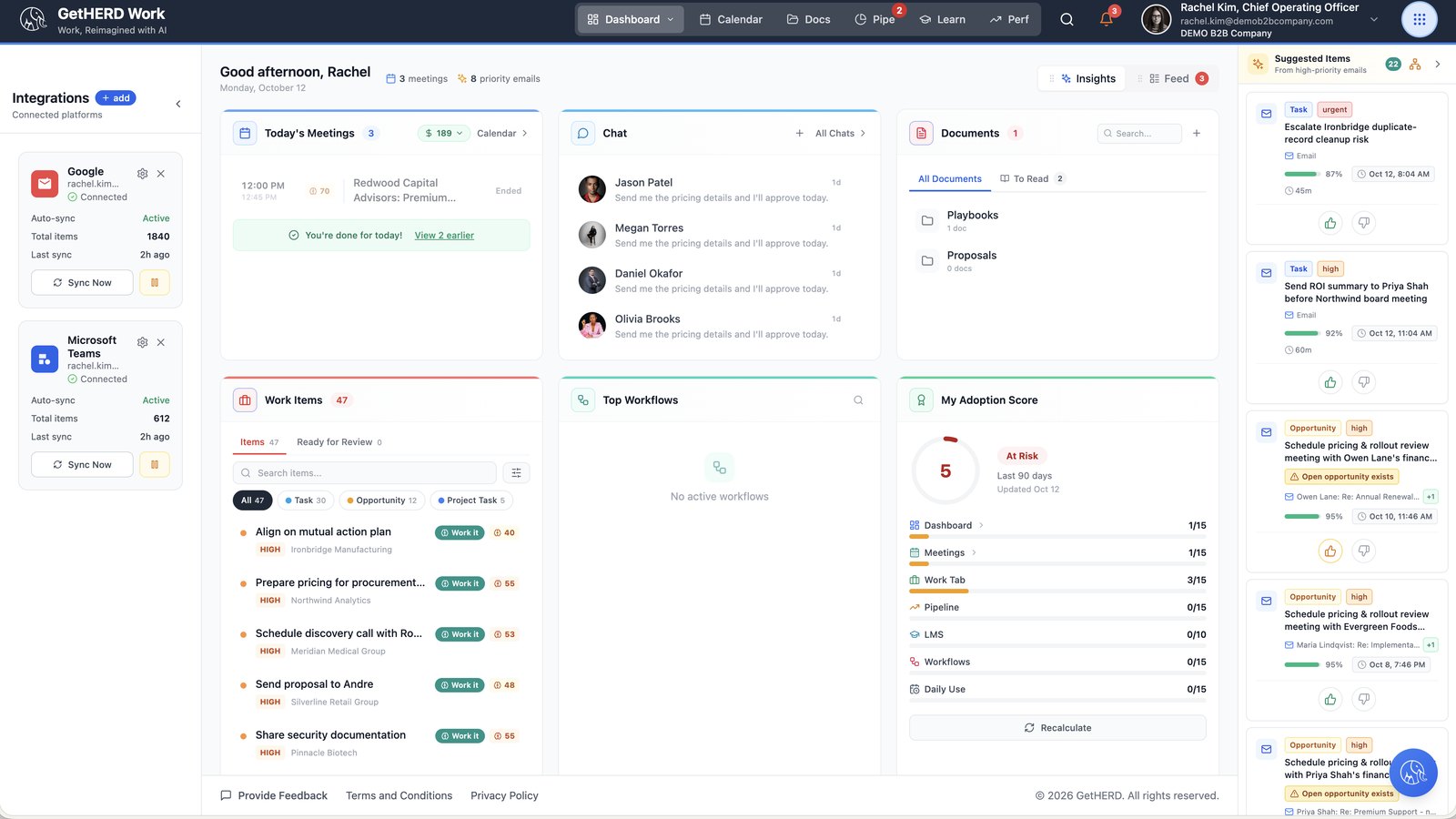
  • Adoption scores per person and team, visible on their own dashboard
  • Feedback from the floor feeds the weekly enhancement list
Herd: Work dashboard with Today’s Meetings, Chat, Documents, Work Items and the My Adoption Score panel
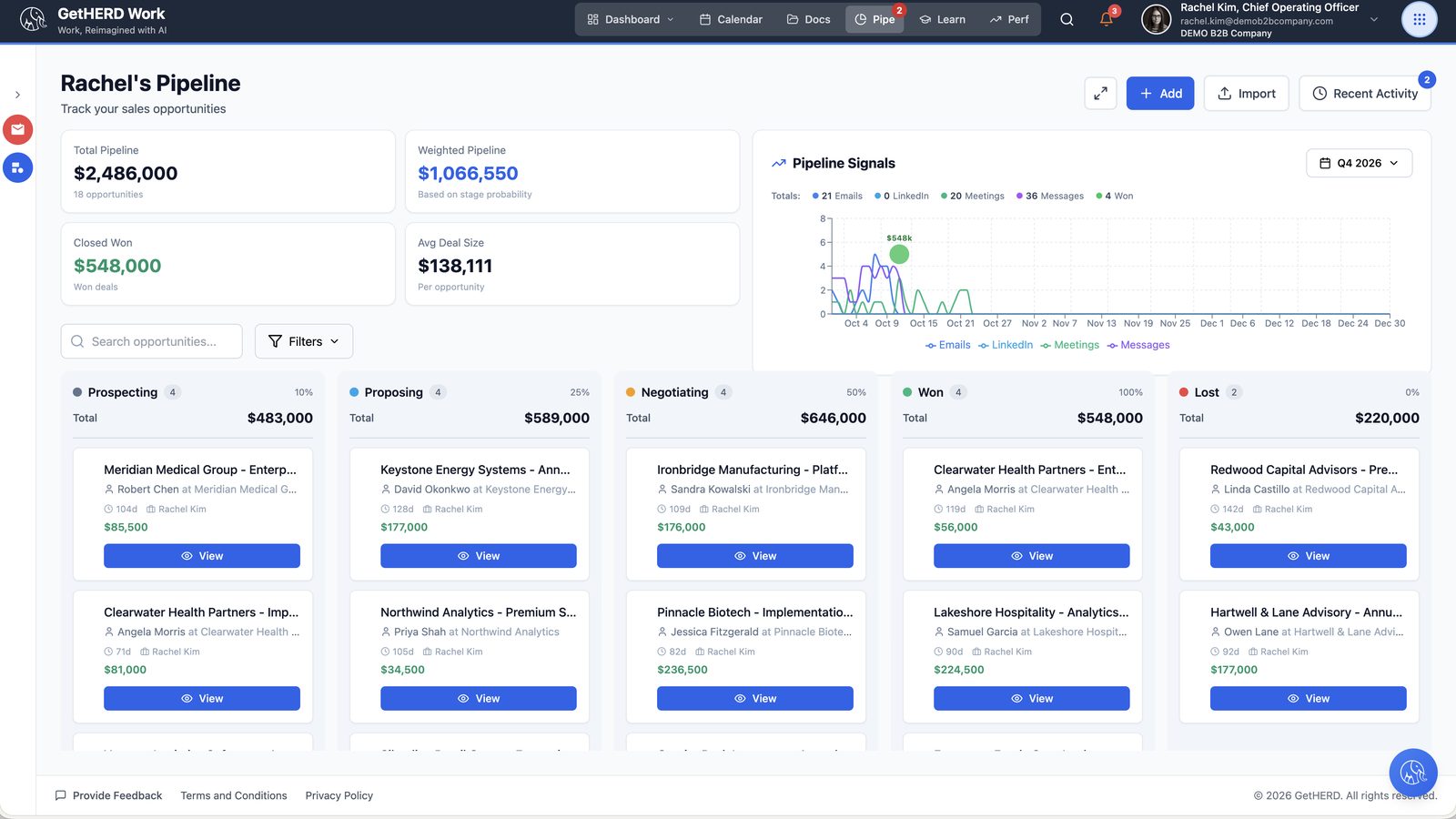
Herd: Work pipeline view with total, weighted and closed-won figures, a pipeline signals chart and a stage board

04 · Deep analytics

Prove the number.

Every use case reports against its own baseline, in the same workspace the work happens in. Not a dashboard you visit; evidence you can take to the board.

  • Baseline versus actual for every use case in the charter
  • Pipeline signals, account and contact health scores, cycle times
  • Ask the data in plain language through the Herd agent
  • Monthly EBITDA impact review with your owner; quarterly re-rank of the ledger

Focus areas

Where the margin lives.

Four functions, each with the P&L lines it moves and the kind of use cases that keep rising to the top of the ledger.

Sales

Moves: revenue, pipeline velocity, win rate

  • Ranked next actions from email, meeting and pipeline signals
  • Account and contact health scores with the gaps to close
  • Meeting prep, follow-ups and quotes handled by agents
  • Scheduling agents that book, confirm and hand off

Typical owner: CRO, VP Sales

Service

Moves: cost to serve, retention, gross margin

  • Support agents that triage, answer from your documents and escalate with context
  • Case-to-resolution workflows with approvals where judgment is needed
  • Renewal and churn signals surfaced to the owner, not buried in a report
  • Knowledge in the flow of work instead of a separate portal

Typical owner: VP Customer Success, Head of Support

Operations

Moves: operating expense, cycle time, app spend

  • Onboarding, procurement and approval workflows that run themselves
  • Handoffs between tools replaced by one workspace and one record
  • Application rationalization: fewer licenses, fewer logins, fewer seats
  • Project delivery tracked against hours, margin and milestones

Typical owner: COO, VP Operations

Finance

Moves: margin, cash, cost of the close

  • Quote-to-cash workflows with configured quotes and approvals
  • Collections follow-ups and dunning run by agents, escalated by rule
  • Close checklists, evidence and sign-offs in one place
  • Software spend and usage visible by team, before renewal

Typical owner: CFO, Controller

How an engagement runs

From P&L line to proof in ninety days.

One retainer covers the software, the team and the outcome. No per-seat licenses, no separate implementation invoice, no handover to a help desk.

Start with a free proof-of-concept
  1. Week 0

    Baseline and charter

    Immersion with the people who do the work. The line, the number, the ledger and the outcome charter — signed before we build.

  2. Days 1–30

    Build and go live

    The top use cases become running workflows in Herd: Work, connected to the tools you already use, with your people trained in the flow of work.

  3. Day 90

    First outcome review

    Baseline versus actual on the charter line, adoption by team, and what we learned. In writing, with your owner.

  4. Every quarter

    Re-rank and expand

    The ledger is re-scored with real data, the next use cases move into build, and the retainer keeps paying for outcomes rather than seats.

Bring us one P&L line.

We’ll come back with the use cases that move it, what each is worth, and a proof-of-concept on your own data at no cost. A founder replies within one business day.